
Understanding the Stages of Change: Supporting Growth One Circle at a Time
Change rarely happens all at once. Whether a young person is learning to manage emotions, build healthier relationships, or make different choices, growth is a process. The Stages of Change Model (or Transtheoretical Model) reminds us that lasting change develops over time and that every stage deserves patience, support, and understanding.
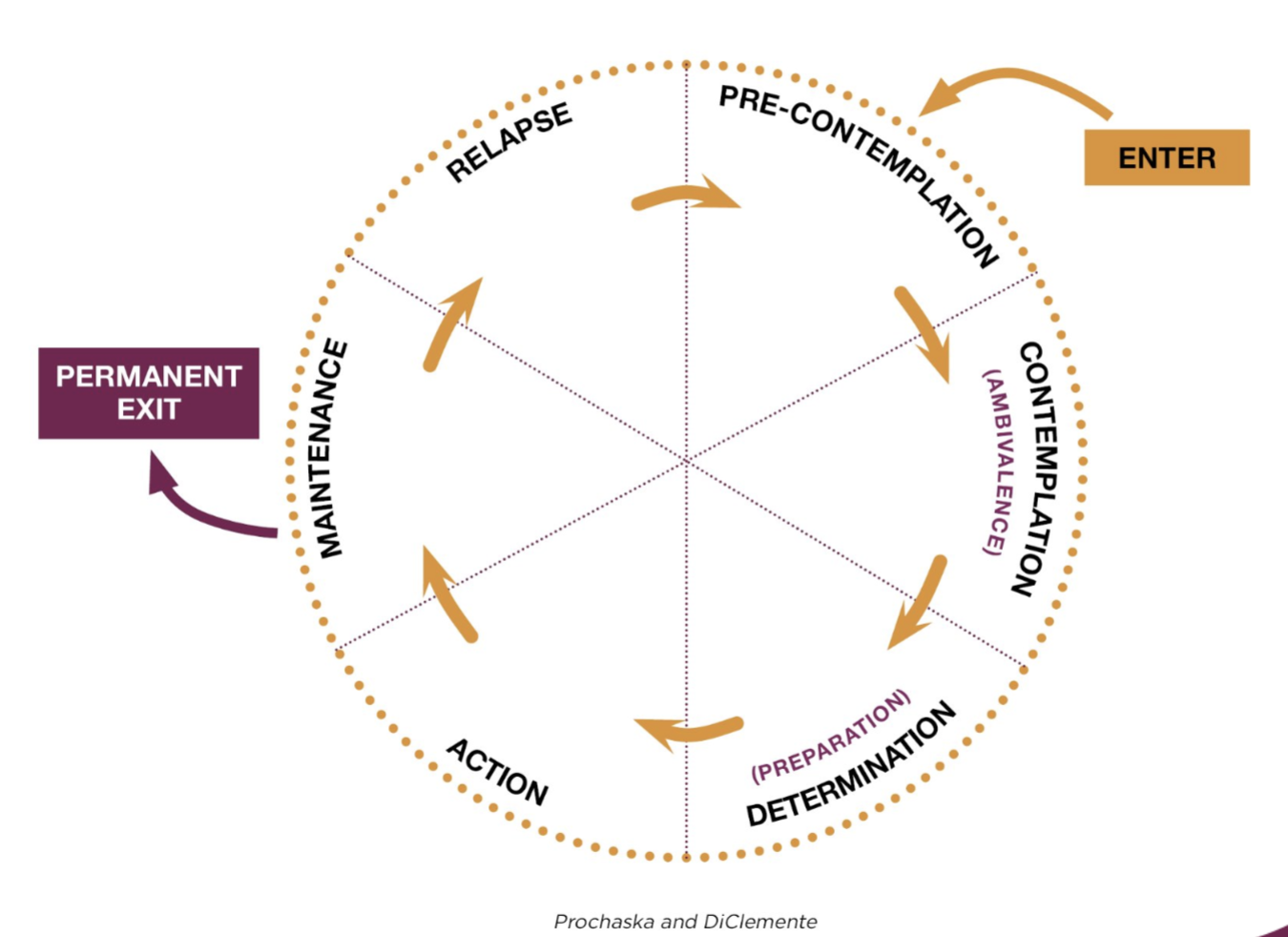
This “Stages of Change” wheel is a visual tool that illustrates the cyclical nature of change in human behavior. Developed by DiClemente and Prochaska (1983), who recognized that people who quit cigarette smoking moved through several identifiable and characteristic stages toward making a change in their behavior. The wheel concept applies to a full range of addictive, habitual, and high-risk behaviors.
At One Circle Foundation, we recognize that participants enter Circle spaces with different experiences, strengths, and readiness for change. Rather than expecting everyone to be in the same place, our Circle model creates a safe, supportive environment where participants can explore their thoughts, wade through ambivalence with support and without judgement, and move forward at their own pace.
Here is how the stages of change can look through a Circle lens, using the example of a teen participant navigating their pattern of anger when faced with conflict:
Pre-contemplation
At this stage, the participant isn't thinking yet about changing how they respond during conflict. They may see conflict as something that “just happens,” or their reactions may feel like part of who they are. In Circle, they’re welcomed without judgment. Through listening to others’ experiences and participating in activities, they begin to feel safe and connected, even before they’re ready to change.
Contemplation
As the participant hears others discuss different ways of handling conflict, they begin reflecting on their own experiences. They start to wonder if there might be another approach. The facilitator recognizes this stage and allows space for the participant to explore what’s good and not good about the behavior, avoiding the inclination to move them straight into action.
Preparation
The participant decides they want to try something different the next time they feel upset. Through Circle activities, they identify personal strengths, practice calming strategies, and think about trusted adults who can support them. They begin to build a plan for how they’d like to respond during future conflicts, and the facilitator and other participants support this step.
Action
The next time the participant disagrees with someone, they pause before reacting. Instead of immediately raising their voice, they take a breath and use one of the communication strategies that were practiced in Circle. It isn’t perfect, but they’re actively putting new skills into practice.
Maintenance
As the participant continues to practice these new skills, responding calmly starts to feel more natural. They recognize the positive impact on friendships, gain confidence in their ability to handle challenges, and can process and celebrate their wins with the Circle.
At this stage, some participants keep building on their progress and may exit the wheel, while others may continue to the next stage.
Relapse
Growth isn't always linear. The participant may find themselves reacting impulsively during a particularly stressful situation and fall back into old patterns. Rather than viewing this as failure, Circle encourages participants to see relapse as a normal part of the change process. Setbacks provide opportunities to reflect, learn, and recommit to the goals they've been working toward. With continued support and connection, participants can move forward again with greater understanding and resilience.
Every Circle is an opportunity to meet participants where they are, honor their unique journey, and remind them that growth happens one step at a time. We can learn from the ancient Taoist sage, Lao Tzu, who asks:
“Do you have the patience to wait till the mud settles and the water is clear? Can you remain unmoving till the right action arises by itself?”
Learn more: The Stages of Change are explored in greater depth during One Circle Foundation facilitator trainings and in the Girls Circle Facilitator Manual and The Council Facilitator Manual, giving caring adults practical tools to recognize where participants are in the change process and support them with empathy every step of the way.
Source:
Prochaska, J. O., & DiClemente, C. C. (1983). Stages and processes of self-change of smoking: Toward an integrative model of change. Journal of Consulting and Clinical Psychology, 51(3), 390–395. https://doi.org/10.1037/0022-006X.51.3.390

Related Products
Leave a Reply
Search The Blog
Categories
- One Circle Foundation
- Spanish
- Facilitator Tips & Tools
- LGBTQ+
- Funding
- Inspiring Stories
- Membership
- Creativity
- Classroom Support
- Trainings
- Facilitators
- Trainers
- Executive Director
- Implementation
- High Impact Practices
- OCF Board
- Autism Awareness Month
- Support Neurodivergent Youth
- Bay Area Training
- Bay Area Professional Development
- Newsletter
- ASCA Conference 2024
- Los Alamos JJAB
- Suicide Prevention
- movember
- Black History Month
- Awareness & Advocacy
- Social Studies
- Mental Health
- Intergenerational Trauma
- Must Read
- Civil Rights & Social Justice
- Freedom & Justice
- Inspiration & Leadership
- Martin Luther King Jr.
- Sexual Assault Awareness Month
- Social Justice
- Mental Health & Wellness
- Community Education
- Voice and Choice
- Mental Health in Education
- Adolescent Behavior
- Teen Psychology
- One Circle
- Emotional Intelligence
- Wellness & Self-Care
- Social Media & Teens
- Personal Growth
- Storytelling / Personal Narrative
- Training
- Curricula
- Girls Circle
- Unity Circle
- Guest Blogger
- The Council for Boys and Young Men
- Womens Circle
Archives
- October 2026
- September 2026
- August 2026
- July 2026
- June 2026
- April 2026
- March 2026
- February 2026
- January 2026
- December 2025
- November 2025
- October 2025
- September 2025
- August 2025
- July 2025
- June 2025
- May 2025
- April 2025
- March 2025
- February 2025
- January 2025
- December 2024
- November 2024
- October 2024
- September 2024
- August 2024
- July 2024
- June 2024
- April 2024
- March 2024
- February 2024
- January 2024
- December 2023
- November 2023
- October 2023
- September 2023
- August 2023
- July 2023
- June 2023
- May 2023
- April 2023
- March 2023
- February 2023
- January 2023
- December 2022
- November 2022
- October 2022
- September 2022
- August 2022
- July 2022
- June 2022
- May 2022
- April 2022
- March 2022
- February 2022