

Addresses Risk Factors for Boys
Rigid beliefs and norms about masculinity are harmful to the health, safety, relationships and opportunities of boys and young men.
These beliefs lead to heightened violence, school dropout, physical and sexual risk-taking, substance abuse, sexual violence, crime, and accidents amongst teen boys*.
Marginalized youth, families and communities are impacted by these risks at greater rates. For marginalized boys, violence is the primary pathway into the school-to-justice system pipeline.
The Council for Boys and Young Men® meets a gender-specific need by addressing and challenging harmful masculinity beliefs and norms and supporting boys in developing safe, healthy identities and behaviors.
How Did It Start?
The Council for Boys and Young Men® developed in response to a request from the field to provide a relational, strengths-based approach for boys, as a parallel to the Girls Circle® model. Service providers saw boys in crisis and asked, "What about the boys?"What is It?
Who Does it Serve?
The model is designed for boys and young men ages 9-18 years, including queer youth who wish to engage in boys' programming, and affirms their right to safe and supportive participation.
While designed for youth, it also serves adult male facilitators by increasing their skills and capacities as role models, mentors, and supportive adults.
How Does it Work?
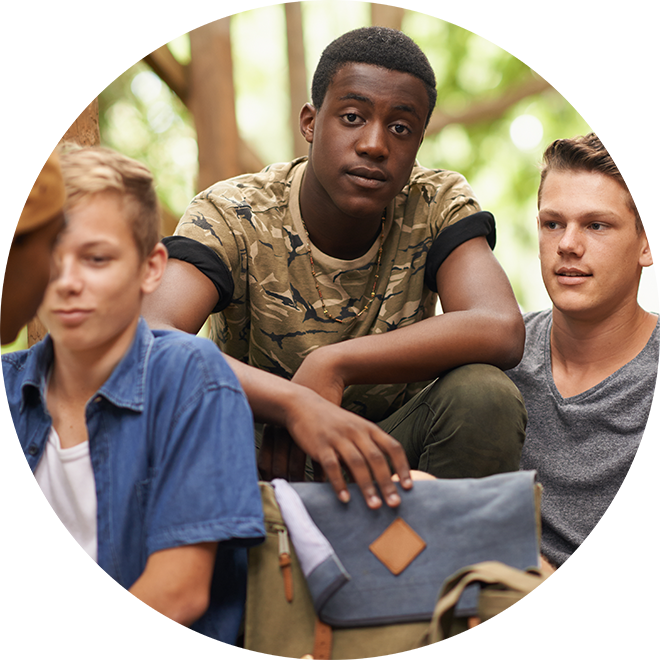
Each week, a group of five to ten boys of similar age and development meet with one or two facilitators for 1.5 to 2 hours. These meetings are held for ten weeks or more, depending on the capacity of the setting. The group format includes warm up activities, a “council” type check in opportunity, experiential activities that address relevant topics, and a reflection and group dialogue component. The focused activities may include group challenges, games, skits or role plays, arts, and so on.
Topics include: Healthy Competition, Bullying, Emotions, Gender Role Expectations, Self confidence, Teamwork, Conflict Resolution, Finding and Using Power in Healthy Ways, Respecting Others' Physical Boundaries, Being Allies, Relationships, Education, Leadership, Community Service, Diversity, Media Messages, Personal Values, Integrity, Future Goals, Early Life Challenges and Overcoming Adversity, Cycles of Addiction and Decision Making, Nature as a Healing Environment, and more.
To participate, boys make a commitment to attend the meetings, and agree to follow co-created community agreements, typically to include: show up, no put-downs or interruptions, offer experiences—not advice; keep the focus on yourself and your experience; and keep what’s said in the group confidential. Facilitators explain confidentiality and legal and ethical exceptions to confidentiality in order to safeguard the boys’ well-being. Boys participate at their own pace. Participants can express a range of ideas and emotions with peers and can expect respect and high regard from one another.
Rather than attempting to “instill values”, the model strengthens and elicits boys’ inherent capacities for good and diverse pro-social values and behaviors.
In What Settings is The Council for Boys and Young Men® Implemented?
*Sabo, D. (1999), Understanding Men's Health: A Relational and Gender Sensitive Approach, Harvard Center for population and Development Studies, working Paper Series, NO. 99.14:Boston, MA