

Making the Classroom Fun: Classroom Tools and Activities
The classroom can feel overwhelming at times. Our students’ behaviors change as the season changes. As we all come back from our Spring Breaks, we are left with two more months before summer vacation. During this time, most of our schools are busy with testing and wrapping up projects, and staff may feel tired and overwhelmed. So how do we keep ourselves and our students engaged when many are just thinking about that last day of school? Here are some class-friendly activities, tips, and tools:
Skill Building Activities
Drawing Blind: Team Building and Communication
This activity highlights how intentional we need to be when communicating with others. Misunderstandings that lead to arguments can typically be avoided if we take the time to ask clarifying questions about the intention and/or meaning of the words one uses to articulate themselves.
Materials:
- Blank paper
- Clipboards
- Pencils
- Printouts of simple drawings… Ice Cream on a Cone, Flower, Smiley Face, etc…
Instructions:
- Pair students off
- Have them sit back-to-back, in chairs, or on the floor.
- Hand one student a clipboard with blank paper on it and a pencil
- Hand the other student a printout with a simple drawing.
- Tell the student they have 2-5min (depending on the age of the students and how complex the drawings are) to describe the picture to their partner, without telling them what it is.
- Once time has expired allow the student to compare their drawings. Then go through the process again switching rolls… If you described the picture in the first round, you will be the drawer in the second.
Debrief:
Ask:
- Did you like that activity?
- What was that experience like for you?
- How close was your partner's drawing to the original?
- What do you think would have made it easier to communicate?
- Do misunderstandings happen in everyday life with your friends? Parents? Teachers?
- How can we improve the way we communicate with each other?
Using the Strength-Based Approach
Tell participants MORE what they are doing WELL than what they are doing wrong. This is the single, most important element of a strengths-based approach. IT WORKS! If you want to see behavior change, NOTICE IT!
Make sure to catch youth doing the good stuff.
Name it and honor it each time. Be intentional in being fair and consistent, as these are often the virtues youth experience negatively in their relationships with adults. For example, the facilitator, teacher, parent, or any caring adult can say things like:
- “You are all showing respect by the way you are listening without interruption to each person who is holding the talking piece.”
- “I’ve observed that everyone planned their day to make sure they got to our circle on time. Thank you for making it a priority.”
- “Our circle is doing really well as a group with confidentiality, bearing witness to each other’s stories and keeping it within our group.”
- “It’s beautiful to see how you all support each other and help each other out.”
- “I've noticed the respect this group has shown by hearing each other’s difficulties and not judging one another.”
- “I noticed today the patience each one of you has shown while we work through this difficult situation.”
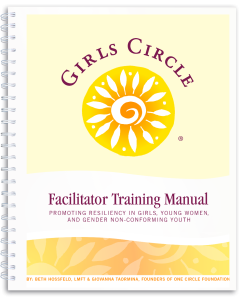
Excerpt from the Girl Circle Facilitator Manual, Unit 3
Self-Care
We all know that self-care is important, we hear it all the time. I recently experienced the importance of it…. My mood changed dramatically within 24 hours after I gave myself permission to do something for myself. Here are some ideas, things you can do in the classroom, for yourself, that can help improve your mood:
Fast and Effective Self-Care Practices:
- Have a cup of tea or coffee
- Put on good-smelling lotion
- Practice deep breathing
- Eat some fresh fruit
- Add lemon or fruit to your water
- Read an inspiring blog
- Write in a 5-minute journal
- Write a gratitude list for your life
- Send a kind text message
- Stretch and move your body
All it takes is 5 minutes to do any of these activities, but doing them every day will increase endorphins, dopamine, serotonin, and oxytocin.


Related Products
Leave a Reply
Search The Blog
Categories
- One Circle Foundation
- Spanish
- Facilitator Tips & Tools
- LGBTQ+
- Funding
- Inspiring Stories
- Membership
- Creativity
- Classroom Support
- Trainings
- Facilitators
- Trainers
- Executive Director
- Implementation
- High Impact Practices
- OCF Board
- Autism Awareness Month
- Support Neurodivergent Youth
- Bay Area Training
- Bay Area Professional Development
- Newsletter
- ASCA Conference 2024
- Los Alamos JJAB
- Suicide Prevention
- movember
- Black History Month
- Awareness & Advocacy
- Social Studies
- Mental Health
- Intergenerational Trauma
- Must Read
- Civil Rights & Social Justice
- Freedom & Justice
- Inspiration & Leadership
- Martin Luther King Jr.
- Sexual Assault Awareness Month
- Social Justice
- Mental Health & Wellness
- Community Education
- Voice and Choice
- Mental Health in Education
- Adolescent Behavior
- Teen Psychology
- One Circle
- Emotional Intelligence
- Wellness & Self-Care
- Social Media & Teens
- Personal Growth
- Storytelling / Personal Narrative
- Training
- Curricula
- Girls Circle
- Unity Circle
- Guest Blogger
- The Council for Boys and Young Men
- Womens Circle
Archives
- April 2026
- March 2026
- February 2026
- January 2026
- December 2025
- November 2025
- October 2025
- September 2025
- August 2025
- July 2025
- June 2025
- May 2025
- April 2025
- March 2025
- February 2025
- January 2025
- December 2024
- November 2024
- October 2024
- September 2024
- August 2024
- July 2024
- June 2024
- April 2024
- March 2024
- February 2024
- January 2024
- December 2023
- November 2023
- October 2023
- September 2023
- August 2023
- July 2023
- June 2023
- May 2023
- April 2023
- March 2023
- February 2023
- January 2023
- December 2022
- November 2022
- October 2022
- September 2022
- August 2022
- July 2022
- June 2022
- May 2022
- April 2022
- March 2022
- February 2022